Product ID in. Optimized design and datasheet out.
An engineer-day of expert Ansys HFSS work per customer configuration became 1.5 hours of unattended agentic work — optimized, verified, documented, and replayable after the fact, with nobody at the keyboard.
Millibeam sells configurable antenna-in-package modules. The Heaviside line spans WiFi 6, WiFi 7, and 5G AiP parts, and every customer order arrives with its own band, gain, and matching requirements — so every configuration has to be verified, optimized, and documented in Ansys HFSS before it ships. That was an engineer-day of expert solver work per part: loading the catalog model, setting targets from the customer spec, optimizing within manufacturer-approved bounds, verifying the winner, and writing the datasheet by hand.
Published with Millibeam's permission. The workflow, scope, figures, and recorded run in this study are verified by Divergent Physics, 2026.
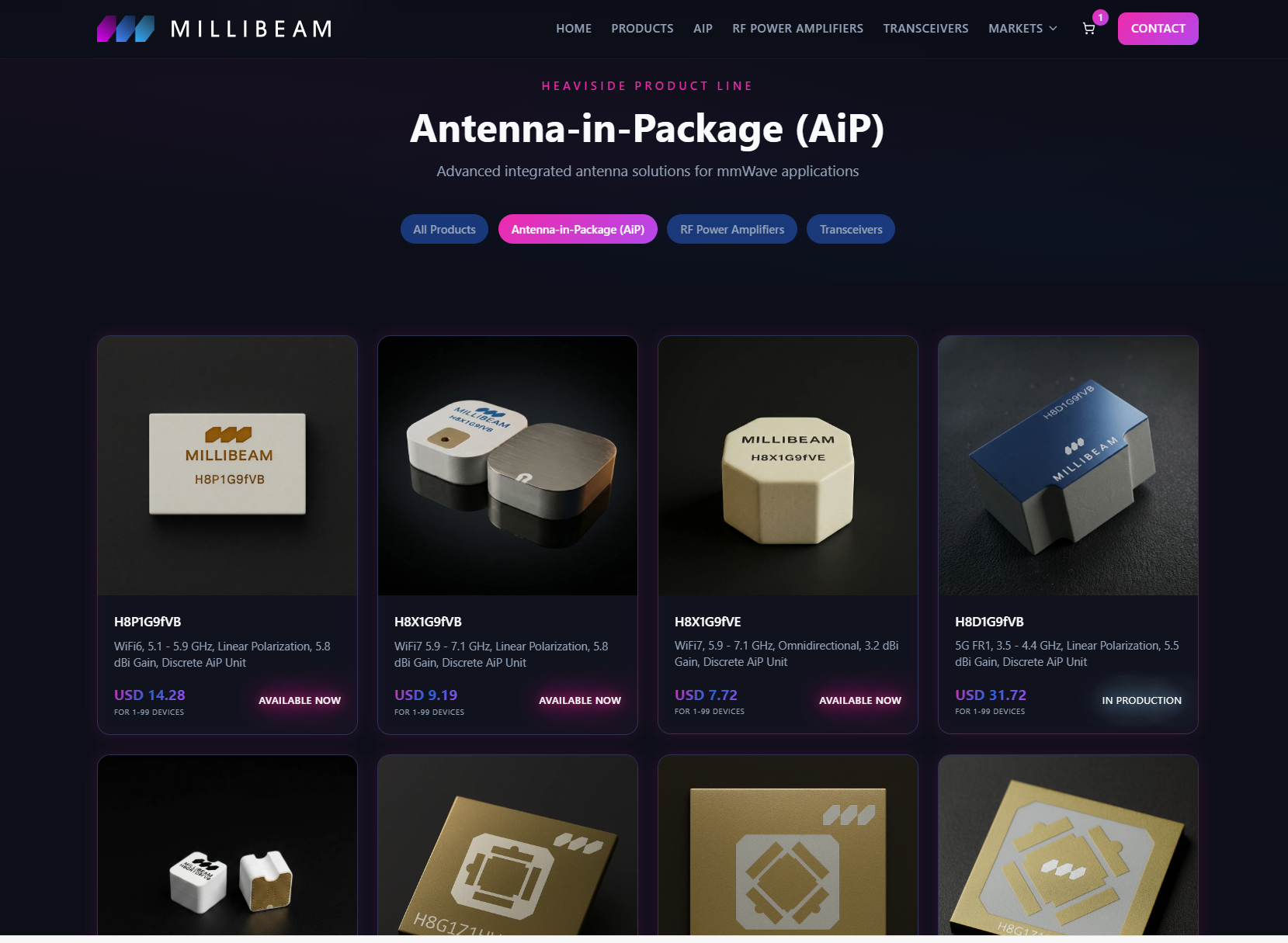
One catalog, thousands of customer-specific variants: the Heaviside line spans WiFi 6, WiFi 7, and 5G AiP modules, and each order arrives with its own band, gain, and matching targets.
The same skill runs any product in the catalog: new part, same process.
Watch the run, start to finish
The complete pilot run in one recording — catalog load, baseline solve, the optimization loop, verification, and the generated datasheet. Unattended from the first frame to the last.
The full Millibeam AiP workflow, one unattended run. Published with Millibeam's permission.
Configuration work is the kind of expert labor that does not compound. Each part needed the same full-wave cycle as the last one, done by someone senior enough to judge whether the result was defensible, and the datasheet at the end was transcribed by hand from the solved model. The cost was an engineer-day per configuration, and the constraint was that it scaled only by adding engineers who could do it — which is exactly the constraint a growing catalog runs into first.
We encoded the team's own process once, as a reviewable skill document the agent follows — data, not code, so their engineers can read, audit, and edit every step of it. One unattended run does the baseline solve, checks KPIs against the customer spec, runs Bayesian optimization over manufacturer-approved parameters only, re-solves the winning candidate to verify it, and generates the customer-facing datasheet — patterns, gain, matching, efficiency — with no hand-editing. Every solve, variable change, and decision is logged, and each run keeps its request, decision log, and working solver project on disk, replayable after the fact.
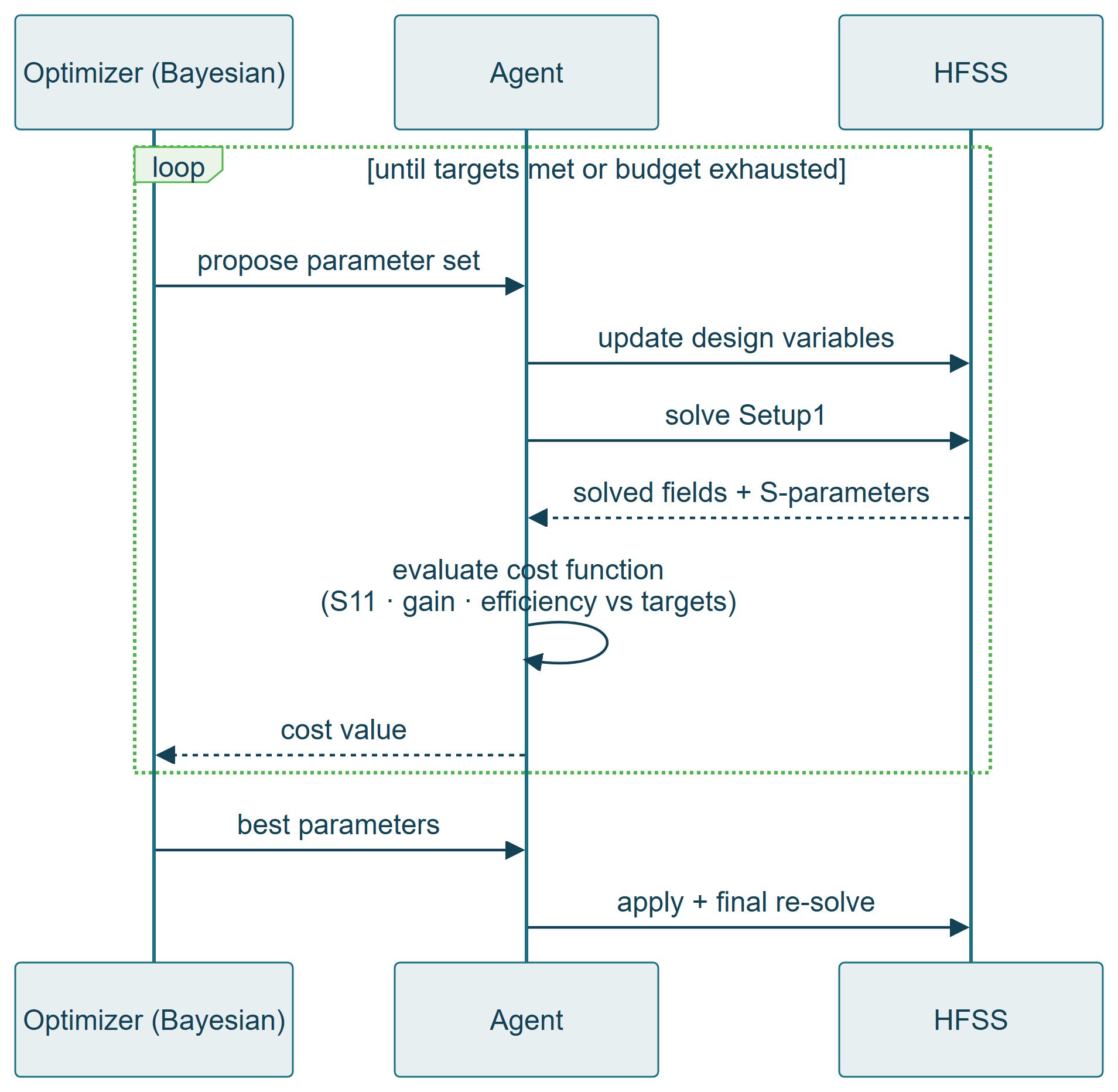
Inside the loop: the optimizer proposes parameters, the agent updates the model and solves in HFSS, scores against spec, repeats — and re-solves the winner before reporting it.
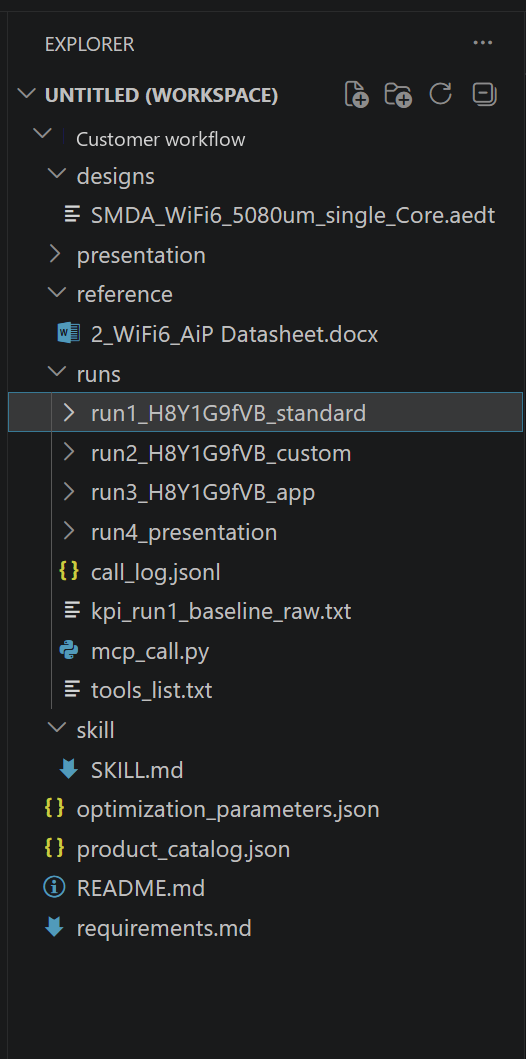
The workflow workspace: product catalog, requirements, the skill document, and one folder per run.
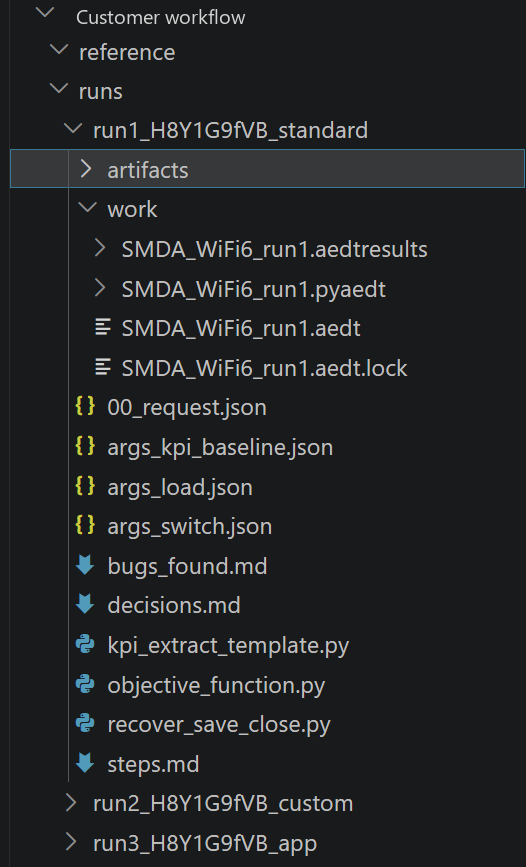
Inside a single run: request, decision log, argument files, and the working HFSS project — replayable after the fact.
Under 5 weeks, start to a working end-to-end run
Can an AI agent run Ansys HFSS optimization unattended?
Yes. In this pilot a single run is 1.5 hours of unattended agentic work covering the full cycle — load the catalog model, baseline solve, KPI check against the customer spec, Bayesian optimization over approved parameters, re-solve of the winning candidate, and a generated datasheet. It explores 20+ full-wave candidates per run with zero human touches in the loop, replacing an engineer-day of expert HFSS work per configuration.
How do you validate a simulation an engineer did not watch run?
Every solve, variable change, and decision is logged, and each run keeps its request, decision log, and working solver project on disk. The run is replayable and reviewable after the fact, and the winning candidate is re-solved before it is reported — so the number in the datasheet comes from a verified solve, not from an interpolated surrogate.
What happens to the automation when Ansys ships a new release?
We carry it. The workflow is encoded as a skill document rather than a scripting project, which is what makes it cheap to keep current, and maintenance against solver-version drift is part of how we deliver rather than a separate project each time.
Run these agents on your own projects
Start a 14-day free trial on top of your existing Ansys HFSS setup — or book a 30-minute demo on a project like yours.